
MERCEDES-BENZ
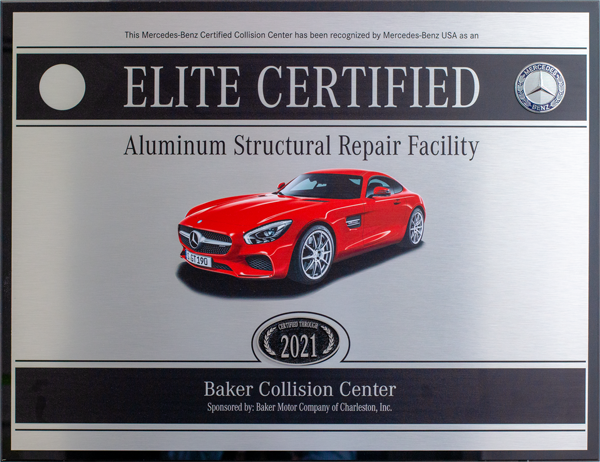
Baker Collision Center is a Mercedes‑Benz Elite Certified Repair Facility
Baker Collision Center has achieved “Elite” certification with the Mercedes‑Benz Certified Collision Repair program. We are authorized to perform collision repairs on all Mercedes‑Benz passenger vehicles including aluminum structural repairs.
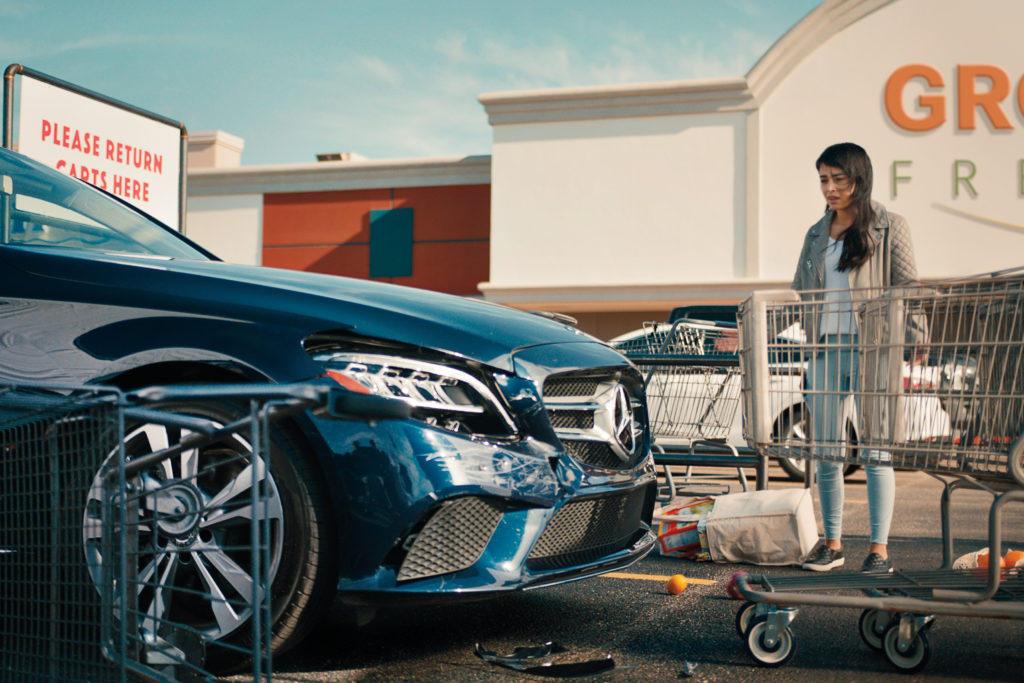
Unfortunately, accidents happen.
Fortunately, we’re here.
BRINGING IT BACK TO “PICTURE PERFECT”
Mercedes-Benz Certified Collision Repair Facilities exist for one purpose – to ensure that your vehicle receives the safety and craftsmanship that your Mercedes-Benz has come to expect.
Baker Collision Center will ensure your vehicle is restored to its pre-collision condition with a commitment to first-class service – with the tools, training, and team needed to restore your vehicle the right way.
OUTSTANDING SERVICE FROM START TO FINISH
From the moment you contact us, we’ll do everything we can to get you back on the road. We’ll assess the damage, suggest a repair, and with your approval, get to work. If needed, a loaner vehicle will be arranged. Being involved in an accident is hard enough. We’re here to make it better.
QUALITY CARE YOU CAN TRUST
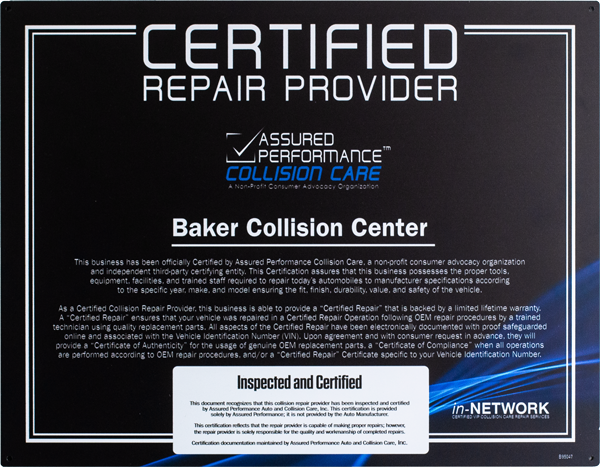
The same care that went into making your vehicle is what goes into repairing it. As a Certified Collision Center, Baker Collision Center technicians are specially trained to restore your Mercedes-Benz to its pre-collision condition using the proper parts and equipment.
MERCEDES-BENZ GENUINE PARTS
Mercedes-Benz Genuine Parts are designed, manufactured, tested and approved to meet the exact specifications of your vehicle. To fit seamlessly, provide maximum safety, and last for the long haul. Plus, they’re covered by the Mercedes-Benz Parts Limited Warranty for up to two years.
Mercedes-Benz USA Position Statements
Diagnostic Repairs Following a Collision
During a collision, some of the vehicle’s sensors could sustain damage internally or in a manner in which failure is not evident to the driver of the vehicle. These vehicle sensors and control units must be evaluated after a collision to ensure that a complete repair is performed, regardless of whether the vehicle notifies the driver of damage or failure via the instrument cluster.
As of model year 1996 (OBDII), vehicles involved in a collision repair should have these systems evaluated using an up-to-date Xentry Kit diagnostics computer:
– Pre-repair scanning and diagnosis of the vehicle is highly recommended. The pre-repair scan will reveal any potential issues early in the estimating and repair process to allow for a more complete estimate of repairs.
– Post-repair scanning and diagnosis of the vehicle is necessary to ensure that the vehicle’s safety and driver-assist systems are operable and fully functioning. Many of the safety and driver-assist systems that may have been activated during a collision require vehicle calibration, normalization, or coding. The post-repair scan will also help to ensure that a comprehensive repair has been performed.
Some examples of when a full Xentry diagnostic scan is required include, but are not limited to:
- Vehicle collisions, regardless of the appearance of damage
- Windshield replacement for vehicles with driver-assist sensors (including rain/light sensors) located in the windshield
- Removal and/or replacement of exterior components, bumpers, SRS sensors, parking sensors, driver-assist system sensors and cameras, wiring harnesses, vehicle control units, seats, or interior trim panels
If a collision repair is necessary, MBUSA strongly recommends that all repairs are performed by a certified technician using only Genuine Mercedes-Benz Parts, mechanical components, and electrical components, as well as all safety devices such as airbags and seat belts.
With constant advancements in the technology of Mercedes-Benz vehicles, always consult Workshop Information Systems – (WIS) for up-to-date and approved repair instructions.
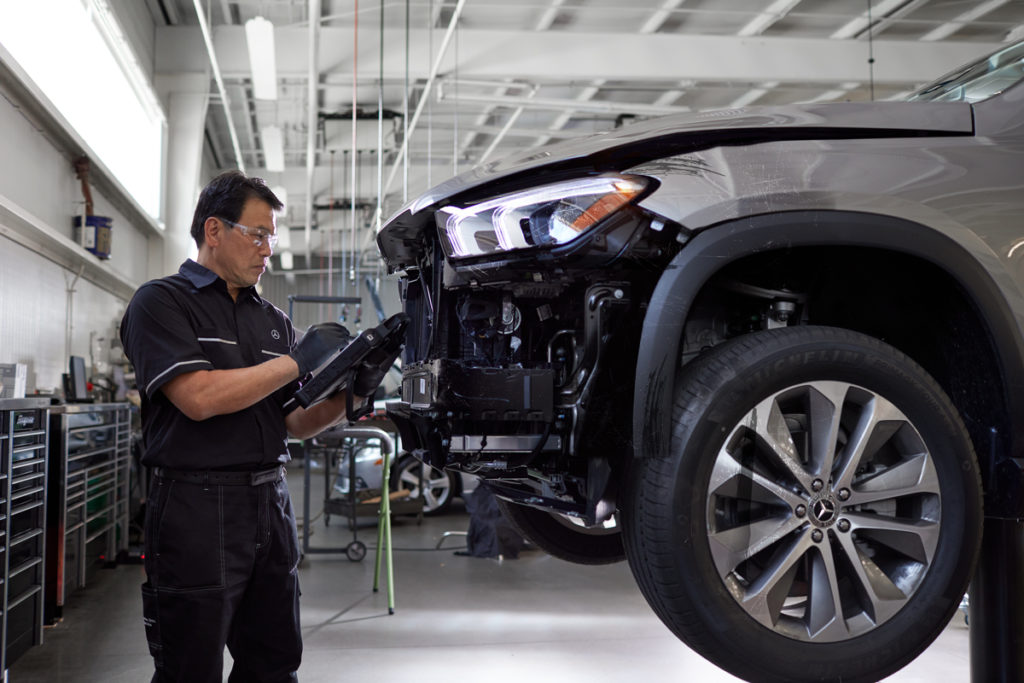
Mercedes-Benz Genuine Replacement Parts
If a collision repair is necessary, MBUSA strongly recommends that all repairs are performed by a certified technician using only genuine Mercedes-Benz body parts, mechanical components, electrical components, as well as all safety devices such as airbags and seatbelts. The official replacement and repair procedures are available in WIS (Workshop Information System), and are continually updated and specific to each model and repair.
-
Aftermarket parts:
Mercedes-Benz does not approve of the use of aftermarket or third-party replacement parts. Mercedes-Benz vehicles are fully tested and certified as an entire assembly. Each part plays a role in the overall operation of the vehicle and is optimized for fit, function, safety, and structural integrity. Aftermarket parts are not subject to the same requirements of entire vehicle operation or function, and may not be manufactured to the same standards or design. This could compromise the overall safety of the vehicle should a future collision occur. In particular, aftermarket parts such as fenders, hoods, bumpers, and doors may not provide proper operation or function of vehicle crumple zones, supplemental restraint sensors (SRS/airbag sensors), or meet federal motor vehicle safety standards for vehicle collisions. Aftermarket parts are not covered under any warranty by Mercedes-Benz, and their use may cause other related components to not be covered under warranty should a failure occur. Genuine Mercedes-Benz replacement parts and accessories installed by certified technicians help preserve the performance and integrity of your vehicle. As well, keeping it genuine with Mercedes-Benz parts will help maintain your vehicle’s residual value. -
Salvaged/Recycled components:
Mercedes-Benz does not approve of the use of components removed from a vehicle that was damaged, burned, flooded, scrapped, or involved in a previous collision. Salvaged or recycled parts may have been subjected to crash impact loads, exposure to outside weather, excessive wear, high temperatures, or extreme forces during removal from the donor vehicle. Mercedes-Benz cannot guarantee the safety, quality, compatibility, or durability of recycled parts as there are no standards in place for testing these components. In addition, salvaged components are not traceable should a recall occur in the future. -
Fasteners:
Mercedes-Benz advises the replacement of all associated fasteners during a collision repair. Fasteners that have been worn, broken, or deformed during a collision must be replaced with Genuine Mercedes-Benz replacement parts. Each structural collision repair is developed and tested using Genuine Mercedes-Benz replacement parts – including rivets, screws, bolts, and other fasteners. The integrity of the complete repair cannot be guaranteed with the use of aftermarket, damaged, or broken fasteners. -
Adhesives:
Mercedes-Benz only allows the use of adhesives that are specified in official published repair documents (WIS). Many technological advances have taken place in the field of structural adhesives for use in Mercedes-Benz vehicles. The use of adhesives in automotive repair is specific to each vehicle and location of repair; these repairs have been fully tested using the components, products, and procedures specified in WIS. The use of other adhesive products not designed for the repair may compromise the safety and durability of the entire vehicle.
Wheel repair and Reconditioning
MBUSA does not endorse the use of reconditioned wheels or any process that claims to restore damaged wheels or rims on any Mercedes-Benz vehicle. Use of any wheel or tire not recommended by MBUSA may compromise safe motor vehicle operation, and may cause loss of control which may result in injury or death.
Reconditioning of damaged wheels typically involves a process that may include heating, straightening, welding, material removal, reshaping, or re-plating. This process can cause deficiencies in the strength of the wheel material. Reconditioned wheel and rims do not meet the production specifications for Mercedes-Benz vehicles and are not an acceptable method of repair.
MBUSA approves only wheel repairs which are limited to surface sanding and cosmetic refinishing processes that remove and replace only paint coatings. Any wheel near the area of any collision damage should be thoroughly examined to ensure that the wheel meets the original safety specifications.

Steering Components
To promote and maintain its rigorous standards of quality and safety, if a repair is necessary, MBUSA strongly recommends that all repairs are to be performed by a certified technician using only genuine Mercedes-Benz parts.
Steering, suspension, and drive axle components are important to a vehicle’s control and handling; their original design, measurements, and integrity are essential to safe operation.
- For safety reasons, the steering gear must be replaced if components of the front axle, steering gear, or any part of the steering linkage are deformed or damaged. A shock transmitted to the steering gear through the front axle or steering linkage may have caused damage that is not externally visible. A pressure test or crack test required for this is not possible in the workshops; therefore the steering gear is to be replaced in cases of doubt. If it is decided that the original steering gear remain in the vehicle, contrary to the intent of this document , we recommend having this decision of the appraiser or insurance company officer confirmed in writing with signature.
- In the event of damage to the engine compartment paneling or the steering plate, the steering gear must then be checked for damage. In particular, the steering gear housing must be visually inspected for signs of external damage and cracks. The steering gear has to be removed to enable inspection to be performed. This is necessary in order to ensure the steering components are not also damaged. In cases of doubt, the steering gear must be replaced.
- In the event of accidents with body damage (e.g. deformed fender, longitudinal member, side paneling, rear end etc.) the steering gear can be used again on condition that parts of the front axle, the steering gear or steering linkage (tie rods, drag link) are not damaged.
- In the event of steering wheel airbag deployment, the steering wheel and steering column tube must always be replaced. Damage can occur to the steering wheel and the steering column tube which is not externally visible.

Replacement Glass & Glazing
To promote and maintain its rigorous standards of quality and safety, if a collision repair is necessary, MBUSA strongly recommends that all repairs are to be performed by a certified technician using only genuine Mercedes-Benz body parts.
Genuine Mercedes-Benz replacement glass is manufactured to tolerances based on the original design. Choosing authentic Mercedes-Benz glass ensures proper fitment, visual clarity, windshield wiper performance, and the overall integrity of your vehicle. Aftermarket variants do not meet the exacting specifications of genuine Mercedes-Benz glass.
- Solar glass coatings provide UV protection and heat load reduction. Aftermarket variants often do not have this reflective technology. This technology optimizes air conditioning performance and can improve fuel economy.
- Genuine Mercedes-Benz glass and the attached moldings have been validated with exposure testing, including UV, chemical, temperature, tear, and abrasion resistance. Aftermarket windshields and moldings are often made with materials that do not meet the standards used in Mercedes-Benz exposure tests.
- Genuine Mercedes-Benz glass can have special acoustic dampening technologies within the layering of the glass. Aftermarket variants usually do not utilize this technology, which may result in increased wind, road, and engine noise in your vehicle’s cabin.
- Genuine Mercedes-Benz glass often incorporates various electrical components, including driverassistance cameras, rain sensors, antennae, and heating elements. Aftermarket glass often does not account for these complex electrical components and may interfere with your vehicle’s electronic systems, or cause these electronic systems to not function properly.
- Glass components are also often a part of the vehicle structural assembly. Using factoryauthored removal and replacement procedures, including the use of advanced adhesives specific to each model, helps ensure that the car is operating at its best.
Genuine Mercedes-Benz replacement parts and accessories installed by certified technicians help preserve the performance and integrity of your vehicle. In addition, using genuine Mercedes-Benz parts helps maintain your vehicle’s residual value.

Get Started!
Book An Estimate Appointment: