
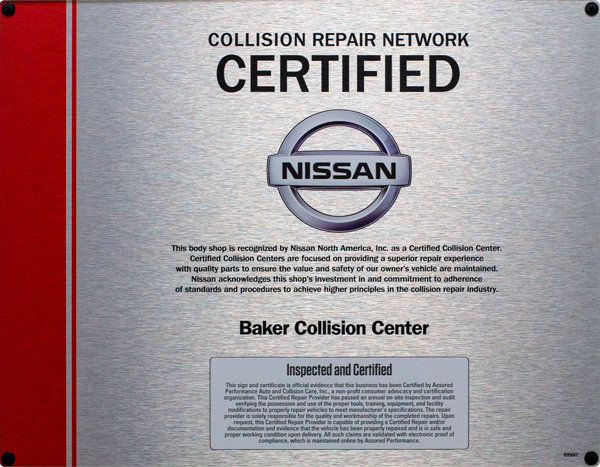
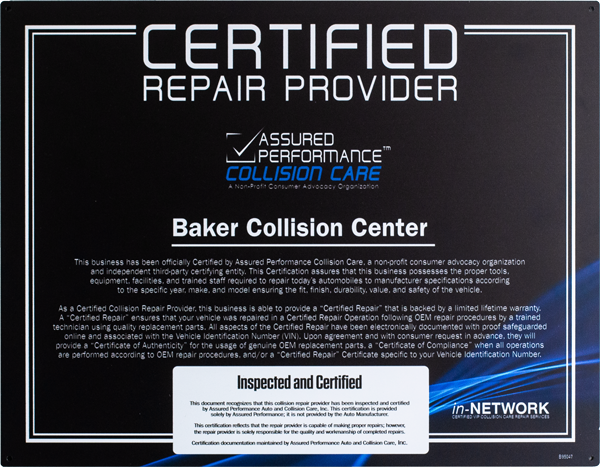
Baker Collision Center is a Nissan Certified Collision Repair Center
Baker Collision Center is a proud member of the Nissan Certified Collision Repair Network. We are authorized to perform collision repairs on all Nissan passenger vehicles including aluminum structural repairs.
Call Nissan Roadside Assistance at 1.800.NISSAN.1 for towing to the nearest Nissan Certified Collision Center.
CERTIFIED COLLISION REPAIR NETWORK
As an Nissan Certified Collision Repair Network collision center, Baker Collision Center has the right technicians, equipment, and tools along with the knowledge to get the job done right. For a timely, high-quality repair, choose Baker Collision Center.
NISSAN CERTIFIED COLLISION REPAIR NETWORK
- Have the peace of mind knowing your vehicle is in good hands and will be repaired using the appropriate parts, tools, and equipment.
- Baker Collision Center prioritizes the use of new Nissan Replacement Parts over others.
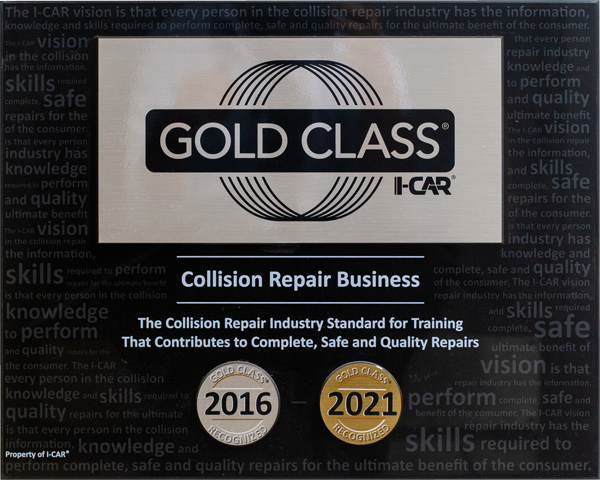
- Baker Collison Center has I-CAR Gold Class® business recognition and our technicians are trained to repair the vehicle to maintain future crash worthiness.
- Limited warranty on collision repairs for as long as you own the vehicle*.
*For complete information concerning coverage, conditions, and exclusions, contact us and read the Certified Collision Center Limited Warranty Overview.
CHOOSING A COLLISION REPAIR CENTER
- Baker Collision Center is the place to start. Ask them for the local Nissan Certified Collision Center or use the locator above to find a Certified Collision Center near you.
- Your insurance company may recommend a collision center but cannot require that you use them. Owners have the right to have their vehicle repaired at a collision center they choose!
- In most cases, the cost for your repair is only going to be your deductible amount (if there is one). So cost should not be your main concern. Consider a collision center that has your interest in mind, not the insurance companies’.
COMPLIMENTARY TOWING
- Call Nissan Roadside Assistance at 1.800.NISSAN.1 for complimentary towing to the nearest Nissan Certified Collision Center.
NISSAN CERTIFIED COLLISION CENTERS FEATURE I-CAR® RECOGNITION
- I-CAR®, the Inter-Industry Conference on Auto Collision Repair, is an internationally recognized educational and training organization for collision repair professionals.
- The I-CAR Gold Class Professionals® designation ensures quality- trained professionals have the knowledge and capabilities required to provide efficient, safe, and high-quality repairs.
- As vehicles incorporate more and more new materials and new technologies, current training has become increasingly important for proper repairs. Gold Class® shops are trained to know:
- How to make the right decisions to contribute to a safe repair
- How to find hidden damage others may not see
- The latest repair procedures and technologies
Nissan Position Statements
Calibration of Around View® Monitor
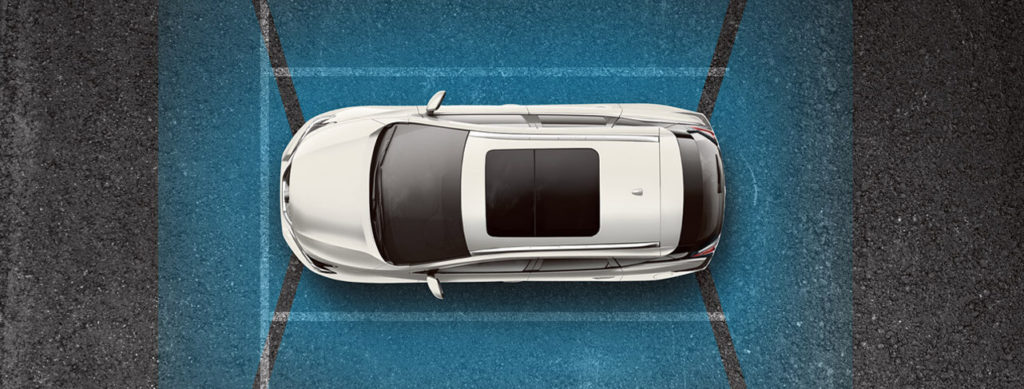
Many Nissan vehicles are now being equipped with Around View® Monitor systems, which incorporate the use of cameras in front, rear, and both sides of the vehicle.
Nissan North America has taken the position that any time a camera, or camera mounting part (front grille, door mirror, or others) is removed, installed, or replaced, it is mandatory for the qualified repair professional to perform a calibration of this system.
Failure to adhere to this calibration procedure could result in the Around View® Monitor system not functioning as originally intended. We ask that the general repair industry adhere to these guidelines immediately.
Reference service manual section “AV” for additional information.
POSITION STATEMENT: Calibration of Around View® Monitor / June 20, 2016 / Reference: NPSB-16-600
Blind Spot Warning (BSW) Precautions
Nissan North America, Inc. (Nissan) continues to be very concerned with the proper repair of our vehicles after a collision situation, especially as it pertains to safety related systems. With this in mind, Nissan would like to address a very important component of our Safety Shield Technologies, called Blind Spot Warning (BSW), and one of the specific repair considerations that relates to this system.
BSW was introduced to some Nissan vehicles as early as 2011. On vehicles equipped with this technology, the side radars, which are responsible for triggering the BSW, sit behind the rear bumper cover at both corners. For this reason, in a rear end collision scenario, Nissan DOES NOT support any repair, body filler application, or paint work on the rear bumper cover in the general area of the side radars. Nissan’s service manuals clearly state: “Do not attach a sticker (including transparent material), install an accessory or paint work near the side radar”.
The damaged bumper cover should be instead replaced with a new bumper cover. In addition, since non-OEM bumper covers may vary in materials, build specifications, and fitment, and have not been tested by Nissan as far as compatibility with the BSW system, Nissan recommends replacing the bumper cover with a new Genuine Nissan bumper cover. Failure to adhere to these guidelines may cause the BSW system to not function properly, potentially causing serious safety concerns for our owners.
Please reference service manual section “DAS” for additional detailed information.
POSITION STATEMENT: Blind Spot Warning (BSW) Precautions / February 21, 2017 / Reference: NPSB/16-725

Bumper Fascia Replacement with Sonar
As Nissan Safety Shield Technologies are incorporated into more of our vehicles, we want to bring to your attention important information about how these systems function, and how to properly handle repairs regarding this technology.
Many electronic sonar sensors in front and rear bumper fascia are considered to be part of this Nissan Safety Shield Technology. These sensors are engineered to be in very exact positions within the bumper fascia, and if not properly installed, may not function as originally intended. For this reason, Nissan North America DOES NOT approve of the use of aftermarket, reconditioned, or recycled bumper fascia. In contrast with original Genuine Nissan bumper fascia, aftermarket bumper fascia may:
In contrast with original Genuine Nissan bumper fascia, aftermarket bumper fascia may:
In some cases, non-OEM fascia come with no pre-drilled holes for the sensors, relying on the shop technician to cut the holes using a rough template. This may lead to instances where the non-OEM bumper does not match the original Genuine Nissan bumper holes.
In some cases, build specifications are slightly different on aftermarket bumper fascia than on Genuine Nissan fascia, which may also cause issues with sensor alignment or performance.
In addition, reconditioned fascia, which was once damaged, may also be out of specification to the original undamaged Nissan bumper fascia, which may cause sensor alignment issues. There is currently no industry standard process for knowing the history/quality of recycled bumper fascia, so this is also not recommended to be used on Nissan vehicles. We ask that the general repair industry adhere to these recommendations.
For additional information, please see service manual section “SN”
POSITION STATEMENT: Bumper Fascia Replacement with Sonar / June 20, 2016 / Reference: NPSB-16-596

De-Nib & Polish and Finish Sand & Polish
Nissan is dedicated to providing vehicles of the highest quality to every owner. Every aspect of the vehicle, from mechanical, safety, and paint finish during the manufacturing process, receives the utmost attention to detail. Restorative paint processes can be one of the most impactful attributes to owner satisfaction when done properly. Repair facilities face a variety of challenges with vehicles including, but not limited to, paint maintenance and debris from daily road conditions.
After refinishing any outer panel, it may be necessary to nib sand (or de-nib) any particles found within the final finish followed by polishing affected areas. It may also be necessary to finish sand and polish an entire panel finish, followed by polishing the affected areas to provide the desired uniform texture of the factory finish.
Nissan also completes these same processes in the manufacturing environment due to intrusive dirt or debris found in the production environment. Paint manufacturer’s recommended guidelines should be followed by qualified trained individuals with proper equipment during this process.
POSITION STATEMENT: De-Nib & Polish and Finish Sand & Polish / December 12, 2018 / Reference: NPSB/18-415
Frame and Unibody Pulling
Nissan vehicles, whether constructed on a framed or unibody platform, require different techniques to correct body alignment issues after a collision, incident, or loss. Repairs requiring any structural or alignment corrections are the first step in the restoration process and the basis of a safe and quality repair.
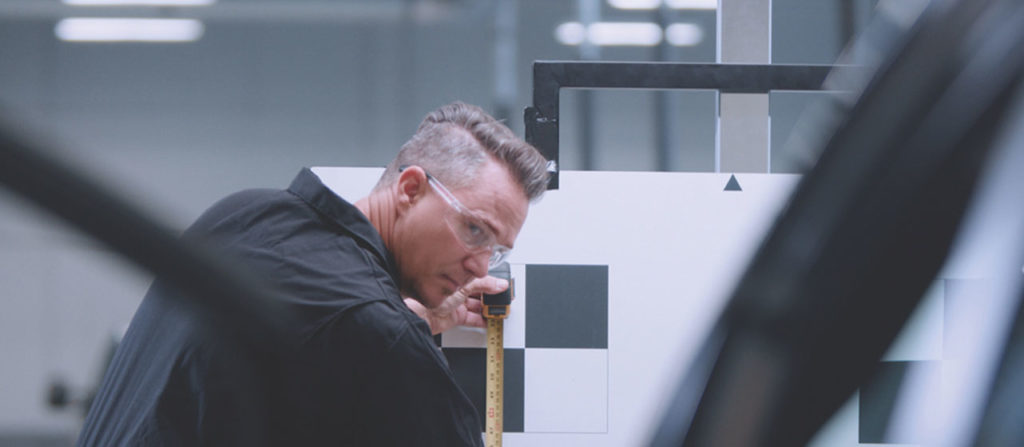
To ensure that a vehicle is repaired and restored to factory specifications, measurements should be taken both before and after a frame or structural repair. This ensures proper body alignment that could affect safety or mechanical systems. Measurements can be found in the Electronic Service Manual (ESM) taken from a variety of control points during production. Nissan North America has not validated any alternative measurements provided by a third party vendor and refers all collision repair professionals to the ESM measurements. Removal of vehicle components, panels, or exterior trim may be necessary to perform accurate measuring during the repair process. Initial damage measurements will also be helpful in repair-versus-replace scenarios.
Proper anchoring techniques should be used during body alignments and may vary depending on the alignment system being used. Recommended anchoring techniques can also be found in the Electronic Service Manual (ESM) for each model. Corrective push/pull methods will be outlined there as well and should be used in conjunction with machine manufacturer’s guidelines. Any protective coating (seam sealer, stone guard, undercoating, corrosion protection, etc.) removed for initial setup or damaged in the repair process should be restored accordingly.
POSITION STATEMENT: Frame and Unibody Pulling / December 12, 2018 / Reference: NPSB/18-416
Windshield and Glass Replacement
Genuine Nissan auto glass plays an important role in the safety of the vehicle by providing structural rigidity, ocular clarity, and integration with advanced vehicle technology. In addition, glass can play a critical role in noise dampening, UV protection, and general occupant comfort and safety. For these reasons, Nissan North America DOES NOT support the use of aftermarket or recycled glass in a repair situation. If an aftermarket windshield is unavoidable in a repair situation, please be sure it meets the same specifications and similar quality to the OEM windshield being replaced.
We ask the general repair industry to adhere to these guidelines when handling glass replacement on Nissan vehicles. For additional information on Nissan vehicle glass, please refer to service manual section “GW”.
Additional Note: As of the 2016 Nissan model line-up, the LEAF, JUKE, Sentra, and Quest all have non-reusable rear view mirrors. Any windshield replacement on these vehicles also requires the rear view mirror to be replaced. For questions specifically related to inside mirrors, please refer to service manual section “MIR”.
POSITION STATEMENT: Windshield and Glass Replacement / June 20, 2016 / Reference: NPSB-16-606
Get Started!
Book An Estimate Appointment:
-
Don’t wait until it’s too late
Although we hope you never experience an automobile crash, accidents do happen. Being prepared ahead of time can help minimize the aggravation that can accompany auto collision repairs.
Be Prepaired
Nissan has developed this Q&A to help you navigate the collision repair process with your insurance company and the body shop. It also will show you the important benefits of having your vehicle repaired with Nissan Collision Replacement Parts.
These parts help preserve the function of the vehicle's safety systems as a whole, as well as the overall appearance, helping to maintain your vehicle’s value.
In addition, there are factors to consider when purchasing insurance that will help make the repair process less of a hassle. Let’s hope this is information you never need. However, the time to think about it is before an accident—when you purchase your insurance policy. after an accident it will be too late.
-
Collision Repair Relationships
-
What are the three primary relationships involved in collision repair?
-
- You and the Body Shop
- You and the Insurance Company
- The Body Shop and the Insurance Company
-
Why are these relationships important?
-
Understanding each of these relationships aids you in making decisions that help protect:
- You and your family
- The performance of your vehicle’s safety systems in the event of a future collision
- The resale value of your vehicle
In those three relationships, YOU are the most important person. YOU have rights you should understand before you purchase your vehicle and drive it for the first time.
-
-
Select the Right Insurance Policy
Choosing the right insurance company and policy can make all the difference when it’s time for repairs. Making a quick decision when choosing a policy can cause major headaches later.
-
Why shouldn’t I just shop around and buy the least expensive policy?
-
If you have an accident, you will likely get what you pay for when it comes to your insurance policy. Many people begin their auto insurance policy search thinking they will never have an accident and, therefore, are looking for the least expensive policy they can buy. The least expensive policy, however, could result in a less satisfactory claims experience.
-
If I’m in an accident, isn’t my Nissan vehicle automatically repaired with parts from Nissan?
-
Not necessarily. when a new Nissan vehicle is built, all the components are Genuine original equipment parts. Nissan has invested millions of dollars in the research, development and engineering of those parts. They are extensively tested as an entire vehicle system to deliver the intended level of safety and performance. Unfortunately, nearly all auto insurance policies allow for the use of alternatives.
-
How can I ensure that repairs are made With Nissan parts?
-
Before you buy insurance, read the policy and know what coverage you are purchasing. Ask your insurance representative about parts and other restrictions prior to purchase. That way you will pay for the protection you want at the price you’re willing to pay. When you purchased your new Nissan vehicle, you bought an original. You can help keep it original by ensuring that your insurance company uses Nissan Collision Replacement Parts.
-
-
Select the Right Collision Repair Facility
OK, so the unthinkable has happened and your vehicle is involved in a collision. Now the collision repair process begins.
-
Who is the first person you should call if you are in an accident and need to repair your vehicle?
- Your Nissan retailer?
- Your insurance company?
- Local body shops?
- Your friends and family?
-
Our advice is to talk to all of them before you select a collision repair facility. When doing this, carefully consider the benefits of each:
Your Nissan Retailer – They were the original source for your vehicle and are your trusted source for maintenance and repairs so they are a good place to start. Ask if they operate or can direct you to a collision shop in the area that is a certified member of the Nissan Collision Repair Network. The Nissan Certified Collision Repair Network has been developed as a dynamic competitive program to recognize and distinguish retailer owned and independently owned and operated body shops that meet or exceed standards for repair work, training, equipment and delivery of customer service.
Your Insurance Company – If filing a claim, your insurance company will need to be called to begin the claims process. They may recommend a shop in your area that they have a relationship with.
Local Body Shops – Check out several. Consider how they handle your inquiry over the phone. Ask them about their facilities, equipment and capabilities. Ask them what part types they use and about shop and technician certifications.
Your Family and Friends – Word of mouth could be one of your best sources for finding a reputable body shop. Sometimes the best advice you can get is from a family member or friend who has gone through the process.
-
I’ve heard about insurance companies having their own direct repair shops. Are they a good choice?
-
If your insurer directs you to one of its direct repair facilities this may be a good choice, but you should check it out prior to taking your vehicle there for repairs. If you are not comfortable with your insurance company’s recommendation, you still have the right to go to another body shop of your choice.
Ultimately, any body shop you select is repairing YOUR vehicle for YOU. You have the right to select the body shop and choose the parts used to repair your vehicle. Your insurance company pays the bill on which you and the body shop have agreed, although you may have to pay any price difference if your insurance policy allows for low cost alternative parts. But all this should be decided and agreed-to before repairs begin, not after the vehicle is returned to you.
-
-
Select the Right Parts
The right parts are critical to your vehicle’s long-term performance and your peace of mind.
-
Why is it so important to have my vehicle repaired with Nissan parts?
-
Today’s vehicles use more advanced highstrength steels, exotic metals and composite materials than ever before. Nissan vehicles also include highly advanced crash avoidance and safety system technologies. It is critical for these systems to be repaired with parts that will deliver the intended level of form, function, performance and safety our engineers originally specified.
The only way to be certain you are getting original equipment performance is to use Nissan Collision Replacement Parts. Unfortunately, many customers tell us they are not aware that anything other than genuine collision replacement parts would be used to repair their vehicle after an accident.
-
Do I have the right to choose Which parts are used in my repairs?
-
Absolutely. A reputable body shop will discuss with you in detail the part types specified to repair your vehicle before it starts repairs. This is required by law in many states. You always have the right to choose the type of parts to repair your vehicle, but your insurance company may make you pay the price difference if your policy allows for the use of low-cost alternatives.
-
How can I tell what types of parts are being specified for my repairs?
-
Have the body shop or insurer explain any acronym or comment on the repair estimate you don’t understand, before you sign the repair authorization. These are the different types of parts you may encounter.
New Aftermarket Collision Parts - Sometimes called “aftermarket part” on the estimate, these copies are made by companies other than Nissan or its OEM suppliers, and may not be made of the same material or to the same tolerances and specifications as Nissan Collision Replacement Parts. As a result, some new aftermarket crash parts may not be of the same quality or have the same performance characteristics as OEM parts.
Salvage Parts - Sometimes called “Salvage,” “Used,” “lKQ” or “Recycled” parts on the estimate, these parts are removed from salvage-yard vehicles. Quality concerns may exist with salvaged parts because the source, condition and durability of the parts are not known. In some cases the part could be a salvaged aftermarket part.
Remanufactured/Reconditioned Collision Parts - Sometimes called “Reman” or “Recon” parts on the estimate, most of these collision parts are removed from salvage yard vehicles or from the scrap heap out behind body shops and reconditioned. Like salvage parts, quality concerns may exist with these parts because the source, condition and durability of the parts are not known. Collision parts that are commonly reconditioned are bumpers, fascias, wheels and lighting.
Nissan Collision Replacement Parts - Sometimes called “OEM part” on the estimate, these parts are designed by Nissan and produced to the same specifications and tolerances as the parts used on the vehicle when it was manufactured. They all meet stringent internal requirements for fit, finish, structural integrity and corrosion protection, and also meet Federal Motor Vehicle standards (FMVss).
When new vehicles are designed and built, each part works together to form systems that are rigorously tested to meet strict internal and government standards. When a non-genuine part is introduced, the characteristics of the overall system can be altered, potentially affecting the safety, drivability or appearance of the vehicle.
Consider Your Options
Making sure you know the difference in part types and approve of the parts being specified for your vehicle – before the repairs begin – can help lead to a more satisfying repair experience.
-
-
It’s All About Value
Carefully consider the use of Nissan Collision Replacement Parts for collision repair.
-
Why?
-
You receive many benefits when you use Nissan Collision Replacement Parts:
Better repair appearance Nissan parts provide a precise fit because they are produced to the same specifications as the new vehicle. This ensures that body lines, contours and gaps are the same as when your vehicle was originally manufactured.
Faster Repair Time - The use of new aftermarket, salvage or reconditioned parts may take more time to install and may require modifications to achieve an acceptable fit, which may ultimately increase order and repair times. Also, Nissan Collision Replacement Parts are readily available at every Nissan retailer.
Improved Structural Integrity - Many parts play an integral role in your vehicle’s overall structural integrity and the function of its safety systems. When Nissan parts are installed using factory recommended materials and procedures, they deliver the same structural performance characteristics as the original parts.
Maintains Vehicle Resale Value - The use of new aftermarket, salvage or reconditioned parts may decrease resale value because of potential poor quality, fit, finish and appearance. using Nissan parts for repairs is one way to help keep your vehicle looking “like new,” which may help to maintain its value and may be required if you’re leasing your vehicle.
Original Manufacturer's Limited Warranty - Nissan Collision Replacement Parts are the only replacement parts warranted by Nissan. Damage to your vehicle or its parts caused by the failure of new aftermarket, salvage or reconditioned parts may not be covered by your Nissan New Vehicle Limited Warranty.
-
-
Know Your Rights
Peace of mind comes from educating yourself and knowing your rights on collision repair before an accident happens. When it comes to selecting the right parts for your vehicle, the only way to truly know what you are getting is to use Nissan Collision Replacement Parts.
Contact:
Your Insurance Company Representative
- Find out exactly what your policy covers, now, before you need it
- Find out what is covered if your vehicle is damaged and needs repairs
- Find out if your policy allows choices when it comes time to choose parts to repair your vehicle
Your State Insurance Commissioner
- Check the laws and regulations that govern insurance policies
- Check the laws and regulations that govern repair facilities
- Know your rights as a consumer when it comes time to repair your vehicle
-
Original Equipment Parts Position Statement
Parts used to originally produce Nissan vehicles are thoroughly tested during the vehicle development process. Vehicles are subjected to a battery of stringent internal tests as well as Federal Motor Vehicle safety standards (FMVss) tests to help ensure all individual components work as a system during a crash sequence and meet or exceed our internal performance standards and the standards of the u.s. Government (National Highway Traffic Safety Administration).
Nissan Collision Replacement Parts meet our stringent requirements for fit, finish, structural integrity and corrosion protection. We strongly recommend the use of original equipment replacement parts for collision repair. use of new aftermarket, salvage or reconditioned parts could result in diminished value of the vehicle, and increased damage in a subsequent collision. Further, these types of parts are not warranted by Nissan, and any damage caused by their use is excluded from Nissan’s warranty coverage.